My first area of support is my friends and family. I have coworker friends, friends from childhood, close family, and family far away. I connect with these supports continuously throughout the day, whether it be a quick greeting in the staff room or an hourlong phone call. These supports help me emotionally and physically because they brighten my mood and help me maintain healthy habits in my life. Without them, I speculate that I would not see a reason to better myself, which means I would not be going to school or even holding a job. I would be very unhappy.
Another area of support is economic. My economic support system stems from my job and helps me pay for a variety of things. It pays for my car which transports me to my job and allows me to be successful. My economic support also helps me attend a graduate program for my field of study. It feeds me and shelters me and supports me to move my life forward. Without this economic support, I would not be able to keep a job or go to school or be healthy. I would likely be homeless and malnourished.
My glasses are an area of support. They help me to see. Without them, I would not be able to drive or complete most types of jobs, including my job with toddlers because of safety and specific
Technology and the internet is a source of support. Almost any question I have can be answered at the push of a button. It connects me with instant and customizable entertainment, with my education, with distant friends and family members, and more. I think the most important aspect of modern technology in my life is that it connects me with my school. Being able to complete an online program has allowed me to keep my job. Without technology, including my laptop, I would not be able to keep my job if I wanted to attend school. I also would have to spend more time in the library. I would have fewer options and resources for entertainment. I think without technology, my life would simply be more work, and daily tasks would take longer. For example, every morning I look up the hourly weather on my phone to see if I should bring rain boots or snow pants to work with me. I suppose I could leave these items in the car, but another alternative would be to watch the weather report on TV or to check the newspaper, which shows weather for an area quite wide. Without technology, I would be inconvenienced a lot, but more importantly, I would not be able to attend school and keep my job. I also would not be able to speak as frequently to my distant friends and family.
The challenge I chose to imagine is having a young child who uses a wheelchair. My first line of thinking is the physical needs- I would need support in customizing my home to be wheelchair accessible. I might need support financially to create this environment. I might need financial support and the support of an expert to find an appropriate vehicle for my child's equipment. I would need support from medical professionals on how to care for my child and which wheelchairs to purchase. I would likely appreciate the support from an insurance company to help pay for the costs of medical care. Support would be needed from my child's care program or school to ensure that my child's medical and physical needs were being met. I would also need support emotionally, since having this challenge might impact me emotionally. I would likely appreciate support from a spouse to help care for the child since his or her medical needs may be strenuous. My child and I would need support from all people in our social circles to ensure that venues for events my child and I would attend would be wheelchair accessible. The list of supports goes on and on. Without these supports, my child and I could be left feeling left-out or even maybe humiliated. I could wind up with injuries to myself from trying to carry my child as he or she aged. I might be financially unstable or even living in poverty because I can't afford the medical care and all the accomodations. I can't imagine trying to live without the supports I listed because it seems exceptionally difficult. I am imainging the possibility of a child who cannot move around but also cannot afford a wheelchair. This would be absolutely devastating to me as a parent because it would feel as though there were a significant limitation. Lack of these supports would lead to my child not being able to fulfill their potential, and me feeling inadequate as a parent and unable to fufill my potential as an advocate for my child.
Saturday, December 3, 2016

Saturday, November 19, 2016
My Connections to Play

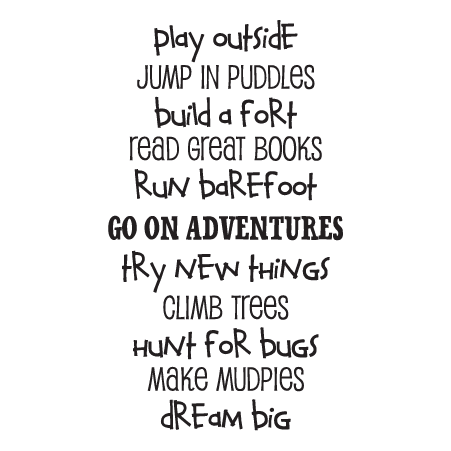


When I was a child, I remember playing all day long. I would go to a daycare during the day and we would play dress up and climb on the rocks outside pretending to be good guys and bad guys. The best days were when the caregivers would let us take the dress up bin outside. We would use costumes and pretend to be cops and robbers and princesses and doctors. At home, I lived in a condominium that owned many acres of woods and trails. Our families would let us roam the woods as long as we were back by dinnertime. I remember my mom telling me many days to "go outside and don't come back until it's dark". The most fun I had was simply exploring- it was really cool to find old (broken) tree-houses, bottles, old tires, and other 'junk' in the woods (it felt like we were discovering it). When I was very young, I remember my family would let me go outside to play as long as I stayed within a certain distance (we used an old rock-wall as a boundary) and I would ride my bike and my scooter and run around and play with the other kids in the condo's. I learned so much from this unsupervised play, it really built a foundation for me to be a confident person and to trust myself and my abilities- I have fond memories of getting stuck in mud, of breaking my arm falling off a bicycle, and other things that weren't fun at the time but taught me lessons about myself. Play taught me about myself and about my interests and skills and helped me make sense of my world.
Unfortunately, nowadays, play has changed a lot. Parents are so afraid to even send their children outside because it is so risky nowadays. Moreover, a lot of people live in areas where there are few play spaces for children (a lack of open woods, a lack of playgrounds, etc). Though we had PlayStation's and other types of screen media when I was a child, we did not use them like the children today use them. I babysat a young child for several months who would use his Nintendo from the time he got out of school to the time he went to bed. I think we are seeing more and more of this type of play as well as structured activities in the lives of young children. Childhood and play is definitely not the same as it used to be. Play was essential to my life, and I hope that it can regain its value as a central focus in the lives of children today and in the future.
Saturday, November 5, 2016
Relationship Reflection
There are many people in my life with whom I have positive relationships. Below, I identify five people with the most positive relationships to me and describe the aspects of the relationship that characterize it as positive. I also detail the factors that help those relationships remain strong.
1. Rich- my fiance. I maintain a strong partnership with him because we have open communication and we live together so we see each other every day. We share a common vision for our future and have committed to this vision. We work together to achieve many things, including taking care of our animals and house. He and I maintain our relationship by doing new things, making sure we have humor, and spending quality time doing things together and enjoying the company of one another. We share a strong relationship because we communicate not only about our wants but also our emotions.
2. Rachel- my friend. Though we live far apart, we maintain a very strong relationship. We began our relationship in school where it was reciprocal; we worked together in a childcare classroom twice a week, and as we experimented doing things wih the children, we learned how to be in sync with the children. We recognized our personalities as complimentary, me being intrinsic, and her, extrinsic, and used this to our strength in the classroom. As we engaged the children together, we developed a closeness and appreciation for one another. We began helping each other with schoolwork, and the relationship blossomed from there. She is now my best friend and soon to be Maid of Honor. She and I have a well-developed sense of one another's personality and we just 'mesh well'. We maintain this relationship despite the long distance even when we do not see each other for long periods of time. It seems that we pick up where we left off no matter how long it has been.
3. Ali- my friend. We met because we have similar family circumstances and she and I understand one another's emotional experiences. We grew up together, which is something I cannot say of any of my other strong relationships and looking back at our teenage years together, I think of all the fun positive things that we experienced together. I think this is one of the strengths of our relationship- we have fond memories of growing up together.
4. Jess- my coworker and friend. We share a partnership because we work in a 'pod' together caring for young children. Her toddler room is next to mine and they are separated by a walk-through kitchen. We partner with and support one another in practical ways (covering bathroom breaks, sharing materials, passing children when we hit ratio) and other ways, like offering emotional support, sharing advice, and sharing our home lives with one another. We have spent time at one another's house. This relationship thrives because I see her every day and we can talk during our breaks and, briefly, on the playground. This is a positive partnership because we support each other emotionally inside and outside of work.
5. Kelsey- my coworker and friend. This is a very strong partnership because we too are friends and coworkers. Moreover, we went through the same bachelor's program, completing our degrees just one year apart. Kelsey and I were friends at school and I developed a type of partnership with her then because we helped each other with homework, especially with classes I had already been through as she was completing them. In turn, Kelsey was a listening ear for me during my transition from knowing nothing about children to becoming a confident teacher. Kelsey and I strengthened our partnership when I invited her to my workplace to complete her final practicum, and later helped her get a job at my childcare center. Even now we are strong partners because we discuss, in a safe relationship, work related issues and support one another and be reflective through ethical challenges.
Being reflective through ethical challenges is an incredible strength that I developed through relationships which are essential in work with families (especially in developing partnerships with families). I strongly believe that the most important lessons I learned from my undergraduate program did not consist of knowledge or skills but rather dispositions- the dispositions I developed early in my work with children are my strongest assets as a teacher and they stem from relationships with my peers. With Ali, my relationship encouraged reflection as we were able to share experiences of growing up together. We continue to reflect on these experiences and learn from our errors even now. Reflection is one way I work toward becoming a better teacher- I think about the things that happen with the children and families in my care and I work toward providing best-practice interactions with them. Reflection is an asset of mine, and I began to develop this skill through strong early relationships and partnerships.
1. Rich- my fiance. I maintain a strong partnership with him because we have open communication and we live together so we see each other every day. We share a common vision for our future and have committed to this vision. We work together to achieve many things, including taking care of our animals and house. He and I maintain our relationship by doing new things, making sure we have humor, and spending quality time doing things together and enjoying the company of one another. We share a strong relationship because we communicate not only about our wants but also our emotions.
2. Rachel- my friend. Though we live far apart, we maintain a very strong relationship. We began our relationship in school where it was reciprocal; we worked together in a childcare classroom twice a week, and as we experimented doing things wih the children, we learned how to be in sync with the children. We recognized our personalities as complimentary, me being intrinsic, and her, extrinsic, and used this to our strength in the classroom. As we engaged the children together, we developed a closeness and appreciation for one another. We began helping each other with schoolwork, and the relationship blossomed from there. She is now my best friend and soon to be Maid of Honor. She and I have a well-developed sense of one another's personality and we just 'mesh well'. We maintain this relationship despite the long distance even when we do not see each other for long periods of time. It seems that we pick up where we left off no matter how long it has been.
3. Ali- my friend. We met because we have similar family circumstances and she and I understand one another's emotional experiences. We grew up together, which is something I cannot say of any of my other strong relationships and looking back at our teenage years together, I think of all the fun positive things that we experienced together. I think this is one of the strengths of our relationship- we have fond memories of growing up together.
4. Jess- my coworker and friend. We share a partnership because we work in a 'pod' together caring for young children. Her toddler room is next to mine and they are separated by a walk-through kitchen. We partner with and support one another in practical ways (covering bathroom breaks, sharing materials, passing children when we hit ratio) and other ways, like offering emotional support, sharing advice, and sharing our home lives with one another. We have spent time at one another's house. This relationship thrives because I see her every day and we can talk during our breaks and, briefly, on the playground. This is a positive partnership because we support each other emotionally inside and outside of work.
5. Kelsey- my coworker and friend. This is a very strong partnership because we too are friends and coworkers. Moreover, we went through the same bachelor's program, completing our degrees just one year apart. Kelsey and I were friends at school and I developed a type of partnership with her then because we helped each other with homework, especially with classes I had already been through as she was completing them. In turn, Kelsey was a listening ear for me during my transition from knowing nothing about children to becoming a confident teacher. Kelsey and I strengthened our partnership when I invited her to my workplace to complete her final practicum, and later helped her get a job at my childcare center. Even now we are strong partners because we discuss, in a safe relationship, work related issues and support one another and be reflective through ethical challenges.
Being reflective through ethical challenges is an incredible strength that I developed through relationships which are essential in work with families (especially in developing partnerships with families). I strongly believe that the most important lessons I learned from my undergraduate program did not consist of knowledge or skills but rather dispositions- the dispositions I developed early in my work with children are my strongest assets as a teacher and they stem from relationships with my peers. With Ali, my relationship encouraged reflection as we were able to share experiences of growing up together. We continue to reflect on these experiences and learn from our errors even now. Reflection is one way I work toward becoming a better teacher- I think about the things that happen with the children and families in my care and I work toward providing best-practice interactions with them. Reflection is an asset of mine, and I began to develop this skill through strong early relationships and partnerships.
Saturday, October 22, 2016
Professional note of thanks


I want to thank you for your contributions to the class over the past eight weeks! It was a pleasure to respond to your discussion board posts and your blog. You offered some great ideas and insights about early childhood development and I really appreciate that you discussed outside scholarly resources and your own experiences, like your sisters' children's births and your friend who gew up in poverty. Well done on the last eight weeks and I hope to see you in future courses!
To Evelyn,
Thank you for your contributions to the discussion boards over the past two months. A few times you and I presented and discussed differing opinions and ideas and it was a pleasure to have those discussions with you. Thank you for using outside scholarly resources and contributing to my knowledge through the discussion boards. Best of luck to you in the rest of your career at Walden and beyond.
Saturday, October 8, 2016
Testing
Assessment and evaluation in early childhood education has a variety of benefits. Assessment can support young children on a grand scale, like in program planning and research, and on an individual basis, like when children are diagnostically evaluated or identified for health and social services (Wortham, 2012). It also helps with accountability standards for schools, teachers, and individual students (Wortham, 2012). Assessment of young children began with Johann Pestalozzi and the child study movement, where children began to be seen as individuals rather than "pre-adults" (Berger, 2016; Wortham, 2012). It evolved as programs like Head Start and federal legislation for children with disabilities attempted to level the playing field for children. According to Wortham (2012), testing should use multiple sources of information, benefit the child and improve learning, involve the child and family, and be fair for all children. Wortham also outlines 9 principles for assessment of young children:
Assessment is ongoing
Assessment focuses on progress
There is a contextual framework for understanding the results
Methods of assessment are appropriate
Assessment includes scaffolded experiences
Assessment involves familial input
Assessments are tailored to a purpose
Major decisions do not rely on assessment results alone
Follow-up occurs after red flags are indicated in assessment.
One major concern about testing in the modern era is its influence on program funding (Fair Test, 2003). Fair Test (2003) suggest that testing young children should result in stronger teaching practices and not serve as an evaluative method. Another concern is fairness- again and again traditional testing, standardized testing in particular, proves to be inadequate for children of cultural and linguistic diversity (Wortham, 2012). The child is a holistic being, and the principles for assessment outlined above help educators and other professionals design, implement, and execute testing that shows a more holistic picture of the child and serves positive purposes that support young children and families.
I was interested in learning more about how testing of young children occurs in England. I learned that a program called National Curriculum Assessments began in the 1990's where children are tested at ages 7, 11, and 14, and has been revamped this year (Richardson, 2016). These tests focus on reading, math, spelling, punctuation, and grammar, and are described as rigorous and face stark criticism among parents, with some families even staging a walk-out of school in response to the updated standards (BBC, 2016). Ethical challenges exist in England too, where the highest performing schools on the Sats (the National Curriculum Assessments) are ranked and published (BBC, 2016). Teachers in England are advocating for a change in policy- they say the tests are too hard (Richardson, 2016). According to Richardson (2016), some of the teachers are wary that the updates to the testing process involve teachers grading their own children’s tests with little guidance on the scoring process. These tests, like many in the United States, focus on only certain aspects of development. In my opinion, these standardized tests are not appropriate for young children and certainly should not inform school ranking or funding. The testing process in England is remarkably similar to that in the United States, and we face similar ethical issues about what makes a test reliable, how to test children, and the purpose for testing children.
References
Assessment is ongoing
Assessment focuses on progress
There is a contextual framework for understanding the results
Methods of assessment are appropriate
Assessment includes scaffolded experiences
Assessment involves familial input
Assessments are tailored to a purpose
Major decisions do not rely on assessment results alone
Follow-up occurs after red flags are indicated in assessment.
One major concern about testing in the modern era is its influence on program funding (Fair Test, 2003). Fair Test (2003) suggest that testing young children should result in stronger teaching practices and not serve as an evaluative method. Another concern is fairness- again and again traditional testing, standardized testing in particular, proves to be inadequate for children of cultural and linguistic diversity (Wortham, 2012). The child is a holistic being, and the principles for assessment outlined above help educators and other professionals design, implement, and execute testing that shows a more holistic picture of the child and serves positive purposes that support young children and families.
I was interested in learning more about how testing of young children occurs in England. I learned that a program called National Curriculum Assessments began in the 1990's where children are tested at ages 7, 11, and 14, and has been revamped this year (Richardson, 2016). These tests focus on reading, math, spelling, punctuation, and grammar, and are described as rigorous and face stark criticism among parents, with some families even staging a walk-out of school in response to the updated standards (BBC, 2016). Ethical challenges exist in England too, where the highest performing schools on the Sats (the National Curriculum Assessments) are ranked and published (BBC, 2016). Teachers in England are advocating for a change in policy- they say the tests are too hard (Richardson, 2016). According to Richardson (2016), some of the teachers are wary that the updates to the testing process involve teachers grading their own children’s tests with little guidance on the scoring process. These tests, like many in the United States, focus on only certain aspects of development. In my opinion, these standardized tests are not appropriate for young children and certainly should not inform school ranking or funding. The testing process in England is remarkably similar to that in the United States, and we face similar ethical issues about what makes a test reliable, how to test children, and the purpose for testing children.
References
BBC (2016, May 16). Primary tests: What are the changes? BBC News. Retrieved from http://www.bbc.com/news/education-35907385
Fair Test (2003). Head Start letter. Retrieved from http://www.fairtest.org/nattest/Head_Start_Letter.html
Richardson, H. (2016, April 29). Primary tests in England too hard, say head teachers. BBC News. Retrieved from http://www.bbc.com/news/education-36160158
Wortham, S. C. (2012). Assessment in Early Childhood Education (6th ed.). Boston: Pearson.Saturday, September 24, 2016
Poverty
My best friend growing up suffered from poverty. Her mom had Multiple Sclerosis and was unable to work. Since her father was not in her life and they did not had any close family, they survived on assistance programs. I know they were eligible for WIC benefits and then later were on disability income. They also used local resources like food pantries and thrift programs (which provided other services like Christmas gifts and reimbursement for summer camps). Even still, they had little food, were always extremely tight on money, and made every effort to get by. They did things like cut laundry sheets in half, planted a huge garden every year, and picked up cans from the side of the road to sell. My friend would mow people's lawns all summer and babysit any time she was available. This economic hardship had a lot of impact on her and her family, which included affects to each domain. There are obvious biosocial effects, including malnutrition, but also, for this family in particular, a tighter maternal bond. They relied on one another more than any materialistic endeavor. Cognitively, my friend learned to cope with 'less' than others. She developed skill-sets and dispositions that I do not have that relate to her growing up in a family that often had inadequate shelter and food, moved houses quite often, and sometimes lived out of their car for short periods of time. Psychosocially, she coped with the influence of stress and a sense of what she describes as "never feeling grounded" which relates to having to move so often because they were short on rent. Poverty has staggering effects on children in my community and others.
In South Africa the effects of poverty seem tragic and surreal. As much as half of the country's population suffers from poverty, and even despite the fact that they have sufficient food resources, many of those in poverty also suffer from food insecurity (Machethe, 2004). Machethe (2004) points to skewed distribution of income while Aliber (2003) implicates the detrimental effects of HIV, AIDS, and other diseases and viruses as main contributors to these statistics. South African News (2006) illustrates the life Khanyi Dlomo, whose family cannot afford for her to attend school, and despite laws against it, has been turned away by schools. South African News describes the slums in Khanyi's hometown as being lined with the mansions of the rich and of another location, Khayelitsha, where nearly everyone lives below the poverty line in shacks or brick structures that do not have running water and has become the epicenter of crime in the area. In this town, the effects of poverty include disease, food insecurity, inadequate safety, and pollution, among others. Though the effects of poverty are prominent and harmful, there exists differences in experiences cross-culturally; the experience of my childhood friend differs greatly from the experience of Khanyi in South Africa.
Aliber, M. (2003). Chronic poverty in South Africa: Incidence, causes and policies. World Development, 31(3), 473-490. Retrieved from http://www.researchgate.net
Machethe, C. L. (2004, October). Agriculture and poverty in South Africa: Can agriculture reduce poverty. In Paper presented at the Overcoming Underdevelopment Conference held in Pretoria (Vol. 28, p. 29). Retrieved from http://www.psu.edu
South African News (2006, July 2). Poverty in the land of affluence. The Southern Times. Retrieved from http://southernafrican.news/2006/07/02/poverty-in-the-land-of-affluence/
Subscribe to:
Posts (Atom)