This week I conducted a conversation with my foreign contact. Molly has been living and working in the Marshall Islands for two years. All of her first- and second-grade students speak Marshallese, and Molly teaches them English. The population is so small that two grades are put together to save money on teachers. This means that the children have varying language abilities in her classroom. Molly has learned a lot of Marshallese, but still struggles with communicating with her learners. There are not a lot of jobs in the Marshall Islands because they have to import a lot of their goods. This means that poverty affects the children in Molly's classroom greatly.
Molly says that some children arrive at school without shoes or adequate clothing. Most of her children do work for their families' farms after school or help with fishing. The US government pays for a lot of the school's resources, so the children are well fed during the day, but Molly says that the children sometimes do not appear to have eaten enough, or they are tired and can not focus. She also says that the children get sick more often and are not able to come to school than when she worked in New Hampshire. The school closes once a month or so because of illness but medicines are at least available to the children from the government. Molly says the situation in the Marshall Islands seems that poverty is more visible and that it affects children more than when she worked in New Hampshire.
What I have realized is that poverty is a global issue that affects children much in the same ways. Molly discussed health and safety, adequate shelter and clothing, and more. These issues are certainly relevant in the continental United States in terms of homelessness, food insecurity, and more. The issues Molly talked about with her children and being able to focus and appearing hungry are things that we see here in New Hampshire. The difference is, of course, that there are a lot more programs here to help with children in poverty. Unfortunately, we do not have a widespread 'cure' for poverty and we have not found a systemic solution for these vulnerable children.
Saturday, January 28, 2017

Saturday, January 21, 2017
Sharing Web Resources
The web resource I chose is the National Association for Early Childhood Teacher Educators (NAECTE). This organization focuses on teachers that interact with adults in the field or adults entering the field of early childhood. My ultimate goal from getting my Master's degree is to become a teacher of new professionals in the field and to conduct training's for teachers. Personally, I have seen a decline in opportunities for teachers in my area to receive professional development. A community-funded program in my area that offered classes for teachers' ongoing professional development recently closed their doors. My colleague Deb spoke with me about the financial and temporal concerns she has as a result of this change- she now must enroll in college course to make up her professional development hours required by licensing (D. Danforth, personal commuication, 28 December, 2016). The climate of professional development for teachers and professional preparation for teachers is an ever-changing dynamic and can only be effective with strong and informed leaders and teachers of these professionals.
The NAECTE puts forth position statements and a newsletter to keep teachers of early childhood professionals up to date with current trends. Their newsletter is mostly news about the organization (board member changes, events, etc.), but their position statements are truly effective and informative for those seeking information about trends and best practices in our field. After reading the position statement describing the code of ethics for early childhood adult educators, I learned so much about what it means to truly prepare teachers. First, it is our responsibility to help (adult) students learn the difference between commonly accepted practice and best practice (NAEYC, NAECTE, ACESS 2004). The NAECTE demonstrates their commitment to all stakeholders in the process of teaching children, outlining their ethical responsibility to (adult) students, to children, to practicum sites, to colleagues, and to higher education institutions. The NAECTE provides adult-education candidates with a holistic perspective about what our society needs in order to improve teacher preparation programs.
One specific aspect of improving teacher preparation programs and early childhood programs that the NAECTE details is providing a more cohesive and aligned teacher certification process. They suggest that teachers of children five years and younger should have extensive coursework and some experience working with young children (NAECTE, n.d.). Given what we know and have learned about the significance of the early years on brain development and the ability of the teacher to help the child and family maximize their potential, I would have to agree that teachers of young children should possess content knowledge, skills, and dispositions necessary to be effective in their work. Recently I had a conversation with a colleague and we discussed a childcare center she worked for several years ago where the director had a business degree and no background in early childhood (T. Chaffee, personal communication, 16 January, 2017). The NAECTE definitely has some relevant informations to my work as a teacher and hopefully as an adult educator. I hope to learn more about this organization as our coursework continues.
References
NAEYC, NAECTE, ACCESS (2004). Code of ethics; Supplement for early childhood adult educators. Retrieved from http://naecte.org/wp-content/uploads/ethics.pdf#page=1&zoom=auto,-39,798
NAECTE (n.d.). Position statement on early childhood certification for teachers of children 8 years and younger in public school settings. Retrieved from http://naecte.org/wp-content/uploads/ECE-certification-position-statement.pdf
The NAECTE puts forth position statements and a newsletter to keep teachers of early childhood professionals up to date with current trends. Their newsletter is mostly news about the organization (board member changes, events, etc.), but their position statements are truly effective and informative for those seeking information about trends and best practices in our field. After reading the position statement describing the code of ethics for early childhood adult educators, I learned so much about what it means to truly prepare teachers. First, it is our responsibility to help (adult) students learn the difference between commonly accepted practice and best practice (NAEYC, NAECTE, ACESS 2004). The NAECTE demonstrates their commitment to all stakeholders in the process of teaching children, outlining their ethical responsibility to (adult) students, to children, to practicum sites, to colleagues, and to higher education institutions. The NAECTE provides adult-education candidates with a holistic perspective about what our society needs in order to improve teacher preparation programs.
One specific aspect of improving teacher preparation programs and early childhood programs that the NAECTE details is providing a more cohesive and aligned teacher certification process. They suggest that teachers of children five years and younger should have extensive coursework and some experience working with young children (NAECTE, n.d.). Given what we know and have learned about the significance of the early years on brain development and the ability of the teacher to help the child and family maximize their potential, I would have to agree that teachers of young children should possess content knowledge, skills, and dispositions necessary to be effective in their work. Recently I had a conversation with a colleague and we discussed a childcare center she worked for several years ago where the director had a business degree and no background in early childhood (T. Chaffee, personal communication, 16 January, 2017). The NAECTE definitely has some relevant informations to my work as a teacher and hopefully as an adult educator. I hope to learn more about this organization as our coursework continues.
References
NAEYC, NAECTE, ACCESS (2004). Code of ethics; Supplement for early childhood adult educators. Retrieved from http://naecte.org/wp-content/uploads/ethics.pdf#page=1&zoom=auto,-39,798
NAECTE (n.d.). Position statement on early childhood certification for teachers of children 8 years and younger in public school settings. Retrieved from http://naecte.org/wp-content/uploads/ECE-certification-position-statement.pdf
Saturday, January 14, 2017
Establishing Contacts and Expanding Resources
In order to connect with two professionals from around the world, I first looked through the links to NAEYC and UNICEF and found no luck. Eventually, after a lot of Googling, I was able to find two professional's email addresses by looking up a town (in my case, London UK and Vancouver BC) and finding websites of elementary schools there. Then I looked at the contact info for those schools and determined if there were teacher's email addresses. I wrote a (hopefully) polite letter explaining how I found them and what my purpose was contacting them. I sent the email on Thursday, so I do hope that I hear back soon from at least one! My tip would be to use my method if you're having issues finding email addresses on the two resources for the blog area this week.
For the resources, I right away chose the National Association for Early Childhood Teacher Educators. I had never heard of this organization and I am very excited to find it! After browsing briefly through their website, I can tell that this truly matches my interests because I want to teach new professionals after I get my degree. I am excited to see what this course has in store for us and more excited to hear back from my global contacts!
For the resources, I right away chose the National Association for Early Childhood Teacher Educators. I had never heard of this organization and I am very excited to find it! After browsing briefly through their website, I can tell that this truly matches my interests because I want to teach new professionals after I get my degree. I am excited to see what this course has in store for us and more excited to hear back from my global contacts!
Saturday, December 3, 2016
My Support
My first area of support is my friends and family. I have coworker friends, friends from childhood, close family, and family far away. I connect with these supports continuously throughout the day, whether it be a quick greeting in the staff room or an hourlong phone call. These supports help me emotionally and physically because they brighten my mood and help me maintain healthy habits in my life. Without them, I speculate that I would not see a reason to better myself, which means I would not be going to school or even holding a job. I would be very unhappy.
Another area of support is economic. My economic support system stems from my job and helps me pay for a variety of things. It pays for my car which transports me to my job and allows me to be successful. My economic support also helps me attend a graduate program for my field of study. It feeds me and shelters me and supports me to move my life forward. Without this economic support, I would not be able to keep a job or go to school or be healthy. I would likely be homeless and malnourished.
My glasses are an area of support. They help me to see. Without them, I would not be able to drive or complete most types of jobs, including my job with toddlers because of safety and specific
Technology and the internet is a source of support. Almost any question I have can be answered at the push of a button. It connects me with instant and customizable entertainment, with my education, with distant friends and family members, and more. I think the most important aspect of modern technology in my life is that it connects me with my school. Being able to complete an online program has allowed me to keep my job. Without technology, including my laptop, I would not be able to keep my job if I wanted to attend school. I also would have to spend more time in the library. I would have fewer options and resources for entertainment. I think without technology, my life would simply be more work, and daily tasks would take longer. For example, every morning I look up the hourly weather on my phone to see if I should bring rain boots or snow pants to work with me. I suppose I could leave these items in the car, but another alternative would be to watch the weather report on TV or to check the newspaper, which shows weather for an area quite wide. Without technology, I would be inconvenienced a lot, but more importantly, I would not be able to attend school and keep my job. I also would not be able to speak as frequently to my distant friends and family.
The challenge I chose to imagine is having a young child who uses a wheelchair. My first line of thinking is the physical needs- I would need support in customizing my home to be wheelchair accessible. I might need support financially to create this environment. I might need financial support and the support of an expert to find an appropriate vehicle for my child's equipment. I would need support from medical professionals on how to care for my child and which wheelchairs to purchase. I would likely appreciate the support from an insurance company to help pay for the costs of medical care. Support would be needed from my child's care program or school to ensure that my child's medical and physical needs were being met. I would also need support emotionally, since having this challenge might impact me emotionally. I would likely appreciate support from a spouse to help care for the child since his or her medical needs may be strenuous. My child and I would need support from all people in our social circles to ensure that venues for events my child and I would attend would be wheelchair accessible. The list of supports goes on and on. Without these supports, my child and I could be left feeling left-out or even maybe humiliated. I could wind up with injuries to myself from trying to carry my child as he or she aged. I might be financially unstable or even living in poverty because I can't afford the medical care and all the accomodations. I can't imagine trying to live without the supports I listed because it seems exceptionally difficult. I am imainging the possibility of a child who cannot move around but also cannot afford a wheelchair. This would be absolutely devastating to me as a parent because it would feel as though there were a significant limitation. Lack of these supports would lead to my child not being able to fulfill their potential, and me feeling inadequate as a parent and unable to fufill my potential as an advocate for my child.
Another area of support is economic. My economic support system stems from my job and helps me pay for a variety of things. It pays for my car which transports me to my job and allows me to be successful. My economic support also helps me attend a graduate program for my field of study. It feeds me and shelters me and supports me to move my life forward. Without this economic support, I would not be able to keep a job or go to school or be healthy. I would likely be homeless and malnourished.
My glasses are an area of support. They help me to see. Without them, I would not be able to drive or complete most types of jobs, including my job with toddlers because of safety and specific
Technology and the internet is a source of support. Almost any question I have can be answered at the push of a button. It connects me with instant and customizable entertainment, with my education, with distant friends and family members, and more. I think the most important aspect of modern technology in my life is that it connects me with my school. Being able to complete an online program has allowed me to keep my job. Without technology, including my laptop, I would not be able to keep my job if I wanted to attend school. I also would have to spend more time in the library. I would have fewer options and resources for entertainment. I think without technology, my life would simply be more work, and daily tasks would take longer. For example, every morning I look up the hourly weather on my phone to see if I should bring rain boots or snow pants to work with me. I suppose I could leave these items in the car, but another alternative would be to watch the weather report on TV or to check the newspaper, which shows weather for an area quite wide. Without technology, I would be inconvenienced a lot, but more importantly, I would not be able to attend school and keep my job. I also would not be able to speak as frequently to my distant friends and family.
The challenge I chose to imagine is having a young child who uses a wheelchair. My first line of thinking is the physical needs- I would need support in customizing my home to be wheelchair accessible. I might need support financially to create this environment. I might need financial support and the support of an expert to find an appropriate vehicle for my child's equipment. I would need support from medical professionals on how to care for my child and which wheelchairs to purchase. I would likely appreciate the support from an insurance company to help pay for the costs of medical care. Support would be needed from my child's care program or school to ensure that my child's medical and physical needs were being met. I would also need support emotionally, since having this challenge might impact me emotionally. I would likely appreciate support from a spouse to help care for the child since his or her medical needs may be strenuous. My child and I would need support from all people in our social circles to ensure that venues for events my child and I would attend would be wheelchair accessible. The list of supports goes on and on. Without these supports, my child and I could be left feeling left-out or even maybe humiliated. I could wind up with injuries to myself from trying to carry my child as he or she aged. I might be financially unstable or even living in poverty because I can't afford the medical care and all the accomodations. I can't imagine trying to live without the supports I listed because it seems exceptionally difficult. I am imainging the possibility of a child who cannot move around but also cannot afford a wheelchair. This would be absolutely devastating to me as a parent because it would feel as though there were a significant limitation. Lack of these supports would lead to my child not being able to fulfill their potential, and me feeling inadequate as a parent and unable to fufill my potential as an advocate for my child.
Saturday, November 19, 2016
My Connections to Play

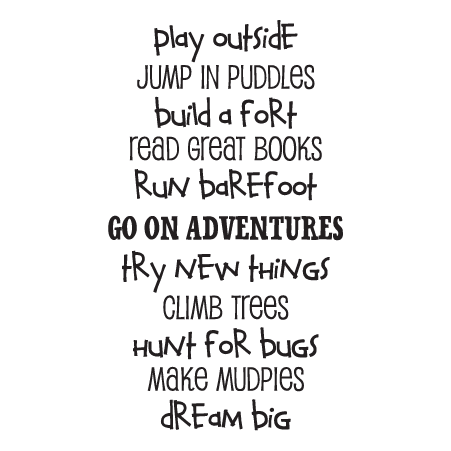


When I was a child, I remember playing all day long. I would go to a daycare during the day and we would play dress up and climb on the rocks outside pretending to be good guys and bad guys. The best days were when the caregivers would let us take the dress up bin outside. We would use costumes and pretend to be cops and robbers and princesses and doctors. At home, I lived in a condominium that owned many acres of woods and trails. Our families would let us roam the woods as long as we were back by dinnertime. I remember my mom telling me many days to "go outside and don't come back until it's dark". The most fun I had was simply exploring- it was really cool to find old (broken) tree-houses, bottles, old tires, and other 'junk' in the woods (it felt like we were discovering it). When I was very young, I remember my family would let me go outside to play as long as I stayed within a certain distance (we used an old rock-wall as a boundary) and I would ride my bike and my scooter and run around and play with the other kids in the condo's. I learned so much from this unsupervised play, it really built a foundation for me to be a confident person and to trust myself and my abilities- I have fond memories of getting stuck in mud, of breaking my arm falling off a bicycle, and other things that weren't fun at the time but taught me lessons about myself. Play taught me about myself and about my interests and skills and helped me make sense of my world.
Unfortunately, nowadays, play has changed a lot. Parents are so afraid to even send their children outside because it is so risky nowadays. Moreover, a lot of people live in areas where there are few play spaces for children (a lack of open woods, a lack of playgrounds, etc). Though we had PlayStation's and other types of screen media when I was a child, we did not use them like the children today use them. I babysat a young child for several months who would use his Nintendo from the time he got out of school to the time he went to bed. I think we are seeing more and more of this type of play as well as structured activities in the lives of young children. Childhood and play is definitely not the same as it used to be. Play was essential to my life, and I hope that it can regain its value as a central focus in the lives of children today and in the future.
Saturday, November 5, 2016
Relationship Reflection
There are many people in my life with whom I have positive relationships. Below, I identify five people with the most positive relationships to me and describe the aspects of the relationship that characterize it as positive. I also detail the factors that help those relationships remain strong.
1. Rich- my fiance. I maintain a strong partnership with him because we have open communication and we live together so we see each other every day. We share a common vision for our future and have committed to this vision. We work together to achieve many things, including taking care of our animals and house. He and I maintain our relationship by doing new things, making sure we have humor, and spending quality time doing things together and enjoying the company of one another. We share a strong relationship because we communicate not only about our wants but also our emotions.
2. Rachel- my friend. Though we live far apart, we maintain a very strong relationship. We began our relationship in school where it was reciprocal; we worked together in a childcare classroom twice a week, and as we experimented doing things wih the children, we learned how to be in sync with the children. We recognized our personalities as complimentary, me being intrinsic, and her, extrinsic, and used this to our strength in the classroom. As we engaged the children together, we developed a closeness and appreciation for one another. We began helping each other with schoolwork, and the relationship blossomed from there. She is now my best friend and soon to be Maid of Honor. She and I have a well-developed sense of one another's personality and we just 'mesh well'. We maintain this relationship despite the long distance even when we do not see each other for long periods of time. It seems that we pick up where we left off no matter how long it has been.
3. Ali- my friend. We met because we have similar family circumstances and she and I understand one another's emotional experiences. We grew up together, which is something I cannot say of any of my other strong relationships and looking back at our teenage years together, I think of all the fun positive things that we experienced together. I think this is one of the strengths of our relationship- we have fond memories of growing up together.
4. Jess- my coworker and friend. We share a partnership because we work in a 'pod' together caring for young children. Her toddler room is next to mine and they are separated by a walk-through kitchen. We partner with and support one another in practical ways (covering bathroom breaks, sharing materials, passing children when we hit ratio) and other ways, like offering emotional support, sharing advice, and sharing our home lives with one another. We have spent time at one another's house. This relationship thrives because I see her every day and we can talk during our breaks and, briefly, on the playground. This is a positive partnership because we support each other emotionally inside and outside of work.
5. Kelsey- my coworker and friend. This is a very strong partnership because we too are friends and coworkers. Moreover, we went through the same bachelor's program, completing our degrees just one year apart. Kelsey and I were friends at school and I developed a type of partnership with her then because we helped each other with homework, especially with classes I had already been through as she was completing them. In turn, Kelsey was a listening ear for me during my transition from knowing nothing about children to becoming a confident teacher. Kelsey and I strengthened our partnership when I invited her to my workplace to complete her final practicum, and later helped her get a job at my childcare center. Even now we are strong partners because we discuss, in a safe relationship, work related issues and support one another and be reflective through ethical challenges.
Being reflective through ethical challenges is an incredible strength that I developed through relationships which are essential in work with families (especially in developing partnerships with families). I strongly believe that the most important lessons I learned from my undergraduate program did not consist of knowledge or skills but rather dispositions- the dispositions I developed early in my work with children are my strongest assets as a teacher and they stem from relationships with my peers. With Ali, my relationship encouraged reflection as we were able to share experiences of growing up together. We continue to reflect on these experiences and learn from our errors even now. Reflection is one way I work toward becoming a better teacher- I think about the things that happen with the children and families in my care and I work toward providing best-practice interactions with them. Reflection is an asset of mine, and I began to develop this skill through strong early relationships and partnerships.
1. Rich- my fiance. I maintain a strong partnership with him because we have open communication and we live together so we see each other every day. We share a common vision for our future and have committed to this vision. We work together to achieve many things, including taking care of our animals and house. He and I maintain our relationship by doing new things, making sure we have humor, and spending quality time doing things together and enjoying the company of one another. We share a strong relationship because we communicate not only about our wants but also our emotions.
2. Rachel- my friend. Though we live far apart, we maintain a very strong relationship. We began our relationship in school where it was reciprocal; we worked together in a childcare classroom twice a week, and as we experimented doing things wih the children, we learned how to be in sync with the children. We recognized our personalities as complimentary, me being intrinsic, and her, extrinsic, and used this to our strength in the classroom. As we engaged the children together, we developed a closeness and appreciation for one another. We began helping each other with schoolwork, and the relationship blossomed from there. She is now my best friend and soon to be Maid of Honor. She and I have a well-developed sense of one another's personality and we just 'mesh well'. We maintain this relationship despite the long distance even when we do not see each other for long periods of time. It seems that we pick up where we left off no matter how long it has been.
3. Ali- my friend. We met because we have similar family circumstances and she and I understand one another's emotional experiences. We grew up together, which is something I cannot say of any of my other strong relationships and looking back at our teenage years together, I think of all the fun positive things that we experienced together. I think this is one of the strengths of our relationship- we have fond memories of growing up together.
4. Jess- my coworker and friend. We share a partnership because we work in a 'pod' together caring for young children. Her toddler room is next to mine and they are separated by a walk-through kitchen. We partner with and support one another in practical ways (covering bathroom breaks, sharing materials, passing children when we hit ratio) and other ways, like offering emotional support, sharing advice, and sharing our home lives with one another. We have spent time at one another's house. This relationship thrives because I see her every day and we can talk during our breaks and, briefly, on the playground. This is a positive partnership because we support each other emotionally inside and outside of work.
5. Kelsey- my coworker and friend. This is a very strong partnership because we too are friends and coworkers. Moreover, we went through the same bachelor's program, completing our degrees just one year apart. Kelsey and I were friends at school and I developed a type of partnership with her then because we helped each other with homework, especially with classes I had already been through as she was completing them. In turn, Kelsey was a listening ear for me during my transition from knowing nothing about children to becoming a confident teacher. Kelsey and I strengthened our partnership when I invited her to my workplace to complete her final practicum, and later helped her get a job at my childcare center. Even now we are strong partners because we discuss, in a safe relationship, work related issues and support one another and be reflective through ethical challenges.
Being reflective through ethical challenges is an incredible strength that I developed through relationships which are essential in work with families (especially in developing partnerships with families). I strongly believe that the most important lessons I learned from my undergraduate program did not consist of knowledge or skills but rather dispositions- the dispositions I developed early in my work with children are my strongest assets as a teacher and they stem from relationships with my peers. With Ali, my relationship encouraged reflection as we were able to share experiences of growing up together. We continue to reflect on these experiences and learn from our errors even now. Reflection is one way I work toward becoming a better teacher- I think about the things that happen with the children and families in my care and I work toward providing best-practice interactions with them. Reflection is an asset of mine, and I began to develop this skill through strong early relationships and partnerships.
Subscribe to:
Posts (Atom)